
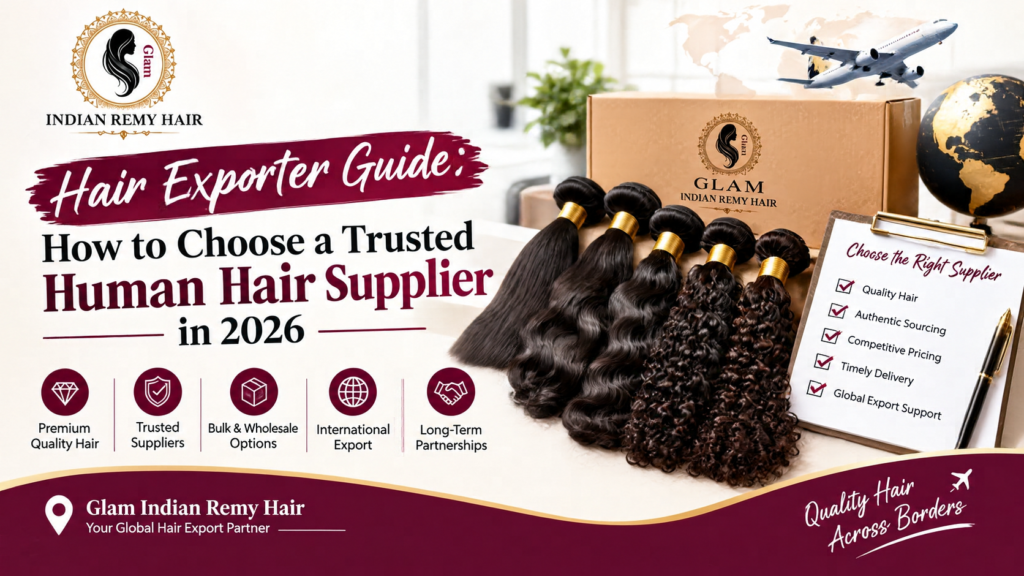
Imagine this. You pay for 50 kg of “100% raw hair.” Six weeks later, the box arrives. The bundles tangle after one wash. The colour is uneven. Half of it sheds in your hands. Your customers are angry, and your money is gone.
This story is more common than you think. The human hair business is growing fast, and with growth comes fake sellers, mixed hair, and false promises. The good news? You can avoid all of it if you know what to check before you pay.
This guide explains, in simple words, how to choose a trusted hair exporter in 2026. You will learn what to ask, what to test, which documents to check, and which red flags to run away from.
Why Is Everyone Talking About Hair Exporters in 2026?
Human hair is now a serious global trade. Industry reports estimate the human hair extension market at around USD 5.9 billion in 2026, with forecasts showing it could pass USD 13 billion by 2034. North America is the biggest buying region.
India plays a huge role here. It is widely described as the world’s largest exporter of human hair, and recent trade reports show that Indian hair exports were worth hundreds of millions of dollars in the 2025-26 financial year. Much of the supply comes from temple donations, village collection, and salon hair.
More demand means more sellers. That is why choosing the right hair exporter matters more today than ever.
What Is a Hair Exporter?
A hair exporter is a business that collects, sorts, processes, and sells human hair to buyers in other countries. Buyers can be wig makers, extension brands, salons, or wholesalers.
A good exporter handles the full journey: sourcing, cleaning, grading, packing, paperwork, and shipping.
Exporter vs. Manufacturer vs. Trader
These words are often mixed up. Here is a simple way to tell them apart:
| Type | What They Do | Pros | Cons |
| Exporter | Sells and ships hair to foreign buyers; may also process it | Handles paperwork and shipping | Quality depends on their sourcing |
| Manufacturer | Makes the final products (wefts, wigs, closures) | Full control over quality and customisation | Higher MOQ in many cases |
| Trader | Buys from others and resells | Flexible, small orders possible | Less control, higher prices, less transparency |
Many strong companies are exporter and manufacturer at the same time. That is often the best choice for brands that want consistent quality.
Why Choosing the Right Hair Exporter Matters
Your supplier is the foundation of your brand. If the hair is bad, no marketing can save you.
Here is what a good exporter gives you:
- Steady quality. Every batch looks and feels the same.
- On-time delivery. You do not lose sales because stock is late.
- Fair pricing. No hidden costs after you pay.
- A long-term partner. Someone who solves problems instead of disappearing.
And here is what a bad exporter can cost you:
- Fake or mixed hair sold as “virgin” or “raw”
- Late or missing shipments
- Wasted money and damaged reputation
- Customs trouble because of wrong paperwork
Know Your Hair: Types Exporters Sell
Before you talk to any supplier, learn the basic terms. Sellers often use these words loosely, so knowing the real meaning protects you.
| Hair Type | Meaning | Best For |
| Raw hair | Cut from one donor, never chemically treated, cuticles all facing one way | Premium extensions, long-lasting wigs |
| Virgin hair | Never dyed, permed, or chemically processed | Customers who want to colour or style freely |
| Remy hair | Cuticles are kept aligned in the same direction, so it stays smooth | Tangle-free bundles and wigs |
| Non-Remy hair | Cuticles are mixed; often chemically treated to look smooth | Budget products (shorter life) |
Tip: There is no single global rule for these words. One seller’s “virgin” can be another seller’s “processed.” Always ask for samples and proof.
Popular Hair Origins
- Indian hair: Strong, natural body, blends well with many textures. Often sourced from temples and villages.
- Brazilian hair: Thicker and silky, popular for wavy and curly styles.
- Vietnamese hair: Fine, straight, and smooth.
- Peruvian hair: Soft with a light-to-medium thickness.
Choose the origin based on what your customers prefer, not just what is cheapest.
10 Key Factors to Check Before Choosing a Hair Exporter
Use this as your checklist. If a supplier fails three or more, think twice.
1. Hair Quality and Sourcing Transparency
Ask where the hair comes from. A trusted exporter can explain their sourcing in simple words, such as temple hair, village collection, or salon hair. If they avoid the question, that is a warning sign.
2. Experience in Export
Someone who has shipped to many countries understands packing, customs, and buyer needs. Ask how long they have been exporting and which countries they serve.
3. Product Range and Customisation
Can they supply different lengths, colours, and textures? Can they make wefts, closures, frontals, or full wigs? More options mean you can grow without changing suppliers.
4. Minimum Order Quantity (MOQ)
MOQ is the smallest order a supplier will accept. Some exporters want large orders, while others welcome small trial orders. Start small if you are new.
5. Pricing and Payment Terms
Compare prices, but do not choose only the lowest one. Very cheap hair is often mixed or low grade. Ask for a clear quote that lists price, packing, and shipping separately.
6. Sample Availability
A real exporter will send samples. Paid samples are normal. A supplier who refuses samples is not a safe choice.
7. Packaging and Private Label
If you run a brand, ask about custom boxes, labels, and branded packaging. This saves you work later.
8. Shipping and Tracking
Ask about delivery time, courier partners, and tracking. Good exporters share tracking numbers quickly and update you at every step.
9. Communication and Support
Do they reply on time? Do they answer clearly? Fast, honest replies before the sale usually mean good support after the sale.
10. Registrations and Documents
A legal exporter should have proper business papers. More on this in the next section.
How to Verify That a Hair Exporter Is Genuine
Anyone can build a nice website. Here is how to check the real business behind it.
Step 1: Check business registration. In India, exporters need an Import Export Code (IEC) from the DGFT. Ask for the number and check that the company name matches. Also ask for the GST registration and company address.
Step 2: Request a video call. Ask them to show their workshop, warehouse, and stock live. A real exporter is happy to do this.
Step 3: Read reviews and ask for references. Look for feedback on trusted platforms, and ask if you can speak with an existing buyer.
Step 4: Order samples first. Never start with a big order. Test the sample (see the next section).
Step 5: Use safe payment methods. Prefer bank transfer with a proper invoice, a letter of credit, or a trade assurance or escrow service for first orders. Be careful with requests to send money to personal accounts.
Red Flags to Watch For
| Red Flag | Why It Is a Problem |
| Price is far below market | Often means mixed, synthetic, or low-grade hair |
| No samples offered | They may be hiding real quality |
| No verifiable address or company papers | Possible scam |
| Pressure to pay fast (“offer ends today”) | Common trick to avoid questions |
| Photos only from social media, no real stock videos | Pictures may be copied from others |
| Only personal bank account accepted | No business accountability |
Hair Quality Checklist: What to Test in Your Sample
When the sample arrives, do not just look at it. Test it.
| Test | How to Do It | Good Result |
| Tangle test | Run your fingers through a wet and dry bundle | Smooth, little tangling |
| Shedding test | Pull the weft gently and shake it | Very few strands fall out |
| Cuticle check | Slide fingers from root to tip, then back | One direction feels smooth, the other slightly rough |
| Burn test | Burn a few strands (outdoors, small piece) | Human hair smells like burning hair and turns to ash; synthetic melts into a hard bead |
| Colour check | Look in daylight | Even colour from root to tip |
| Length and weight | Measure and weigh | Matches what was promised |
| Wash test | Wash, dry, and style once | Texture holds; no chemical smell |
Take clear photos and notes. If the bulk order looks different from the sample, you will have proof.
Understanding Price, MOQ, and Payment Terms
Hair prices change often, so always ask for a fresh quote. Here is what affects the price:
| Factor | How It Affects Price |
| Length | Longer hair is rarer, so it costs much more |
| Origin | Some origins and hair types are in higher demand |
| Grade and type | Raw and single-donor hair costs more than blended hair |
| Colour and processing | Dyed or machine-wefted hair adds cost |
| Order size | Bigger orders often get better rates |
| Market demand and supply | Prices rise when collection is low or demand is high |
A smart payment plan for new buyers:
- Pay for a small sample.
- Place a trial order.
- Once trust is built, move to bigger orders and agreed payment terms.
Shipping, Customs, and Import Rules
Shipping is where many first-time buyers make mistakes. Plan this before you order.
- Air freight or express courier: Faster (often a few days to about two weeks), higher cost, best for samples and small orders.
- Sea freight: Cheaper for very large shipments, but takes longer.
Documents you will usually need:
- Commercial invoice
- Packing list
- Bill of lading or airway bill
- Certificate of origin (if required)
- Any product or health documents your country asks for
Important: Every country has its own import rules, duties, and taxes. Rules for human hair can change, so check with your local customs office or a licensed customs agent before you order. Also ask your exporter whether the price is FOB, CIF, or DDP, because this decides who pays for shipping, insurance, and duties.
12 Questions to Ask a Hair Exporter Before You Order
Copy these into your next email or chat:
- Where do you source your hair?
- How long have you been exporting, and to which countries?
- Can you send samples? What is the cost?
- What is your MOQ?
- Is the hair raw, virgin, or Remy, and can you prove it?
- Can you share your IEC, GST, and company details?
- What are your payment terms?
- How long will production and delivery take?
- Do you give tracking details?
- What is your return or replacement policy if the hair is wrong?
- Do you offer private label and custom packaging?
- Can I speak to one of your current buyers?
A good exporter will answer these without getting annoyed. In fact, they will respect you more for asking.
Benefits of Working With a Direct Hair Exporter
Buying straight from the exporter, instead of through several middlemen, brings real advantages:
- Better prices. Fewer people in the chain means fewer extra margins.
- More control over quality. You can ask for specific grades and checks.
- Faster communication. You talk to the people who actually make decisions.
- Consistent supply. Direct partners can plan stock for your needs.
- Easy customisation. Lengths, colours, wefts, and packaging can be adjusted for your brand.
Frequently Asked Questions (FAQs)
How do I find a reliable hair exporter?
Start with trusted B2B platforms, trade directories, and referrals. Then verify business papers, request samples, and do a video call before paying for a bulk order.
What is the minimum order for bulk hair?
It depends on the supplier. Some accept small trial orders, while others need larger quantities. Always ask for the MOQ in writing.
Is raw hair better than Remy hair?
Raw hair is usually less processed and often lasts longer, but it costs more. Remy hair is a good middle option if the cuticles are truly aligned. The best choice depends on your budget and customers.
How long does international shipping take?
Express air shipping often takes a few days to two weeks, depending on the country and customs. Sea freight takes longer. Ask your exporter for an estimate with the quote.
Can I get private label packaging?
Yes, many exporters offer custom boxes, labels, and branding. Ask about the MOQ for custom packaging, as it can be different from the hair MOQ.
How can I know if the hair is real human hair?
Do a burn test on a small piece and check the feel and smell. For bigger orders, you can also have the sample checked by a lab.
Conclusion
Choosing a hair exporter is not just about price. It is about trust, quality, and a long-term partnership.
Here is the quick version to remember:
- Learn the hair terms (raw, virgin, Remy).
- Check the exporter’s papers and sourcing.
- Always order samples first and test them.
- Compare quotes, but do not choose only the cheapest.
- Use safe payment methods and clear paperwork.
- Start small, then grow with a supplier who proves themselves.
Do your homework now, and you will save money, time, and stress later. Ready to find a supplier you can count on? Contact us today for samples, a custom quote, or bulk order details.
© 2026 Glam Indian Remy Hair. Design by BringOn Digital.